I have reviewed a lot of things that promised to change my life and delivered a shrug. So when I tell you a tablet that dissolves in your stomach is actually one of the more interesting engineering stories in medicine right now, understand that I don’t say that lightly. Semaglutide, the molecule behind Ozempic and Wegovy, spent years as a needle-only product because peptides and stomach acid have the relationship of a paper boat and a blender. Then somebody found a way to sneak it past the blender. Two tablets are now FDA-approved because of that trick. Let’s actually look at what’s being sold here, because “swallowable Ozempic” is a headline, not a review.
The hype
The pitch, as pitches go, is a good one: same drug, same weekly-injection-grade molecule, no needle, just a pill you take with your coffee. Except you don’t take it with your coffee, and that’s where the actual review starts.
First, what semaglutide is chasing. Your gut already makes a hormone called GLP-1 after you eat. It nudges your pancreas to release insulin, slows your stomach down, and tells your brain you’re full. It’s a genuinely good hormone. Its one flaw, from a drug-development standpoint, is that it degrades in minutes. Semaglutide is an engineered copy of GLP-1 built to survive about a week per dose instead of minutes, which is why it became a once-weekly shot sold as Ozempic (diabetes) and Wegovy (weight loss). Same molecule, whether injected or swallowed. The delivery is the whole story.
And the delivery is the hard part, because your digestive tract’s entire job description is “take proteins apart.” Swallow semaglutide plain and stomach acid and enzymes will happily dismantle it before it does anything useful, and whatever survives is too large to slip through the gut wall anyway. That’s not a semaglutide-specific problem. It’s why insulin has been injected for a century. The needle exists to skip the stomach entirely.
The honest grade
Here’s the part where the pitch actually earns something. The trick that makes the pill work is an ingredient called SNAC (sodium N-(8-(2-hydroxybenzoyl)amino)caprylate, a name only a chemist could love), co-formulated directly with the semaglutide in the tablet [3][4]. SNAC doesn’t armor the peptide. It briefly changes the local conditions right where the tablet dissolves against the stomach lining, raising pH just enough, just long enough, to protect a fraction of the drug and help it cross into the blood before things go back to normal [3][4]. It’s less a suit of armor and more a bribe paid to the bouncer for thirty seconds of looking the other way.
I’ll give that mechanism a genuinely good grade. It’s clever, it’s specific, and it’s the actual invention here, not the peptide itself. Which means the loose “semaglutide powder” you might see floating around outside a real pharmacy is not the same product as the approved tablet, even with an identical peptide inside. No SNAC, no bribe, no absorption. The co-formulation is the product [3][4].
But every clever trick has a catalog of fine print, and this is where I dock points for user experience, while still admitting the fine print is earned. The SNAC bubble is fragile. Food in your stomach, or more than about 4 ounces of water, dilutes it, and your dose absorbs far less [3][4]. That’s the entire reason both approved products carry the same ritual: take it first thing, empty stomach, no more than a small sip of water, then wait at least 30 minutes before eating, drinking, or taking anything else [3][4]. Skip that and you haven’t taken a weaker dose. You’ve mostly taken nothing. This is a drug that punishes a rushed morning, and I think that’s a fair trade for “no needle,” but it’s not nothing.
Then there are two versions of it, which trips people up more than it should. Rybelsus is the diabetes tablet, first approved in September 2019 as the first-ever oral GLP-1, in 3, 7, and 14 mg strengths, with 3 mg just a starter dose and 7 or 14 mg doing the actual work [3][5]. In October 2025 the FDA also cleared it to reduce major cardiovascular events in adults with type 2 diabetes and established heart disease, the first oral GLP-1 with that indication [7][8]. Then there’s the oral Wegovy tablet, approved December 22, 2025 at 25 mg, the first oral GLP-1 ever cleared specifically for weight management [1][2]. Same molecule, same SNAC trick, higher dose, different job. If someone tells you they’re “on oral semaglutide” without saying which one, that’s like someone telling you they drive “a car.”
Does it actually deliver
This is the part of any review where the marketing meets the data, and semaglutide’s numbers are real, if you read them at the right resolution.
On the diabetes side, the PIONEER 1 trial had the 14 mg dose dropping HbA1c by about 1.4 percentage points from a baseline near 8%, against 0.3% for placebo, with about three-quarters of people on 14 mg getting under 7% HbA1c over 26 weeks [10]. On the cardiovascular side, the SOUL trial put 9,650 adults with type 2 diabetes and existing heart or kidney disease on oral semaglutide or placebo, and over roughly 47.5 months it cut major cardiovascular events by 14% [7]. That’s a legitimate, hard-won result, not a marketing footnote.
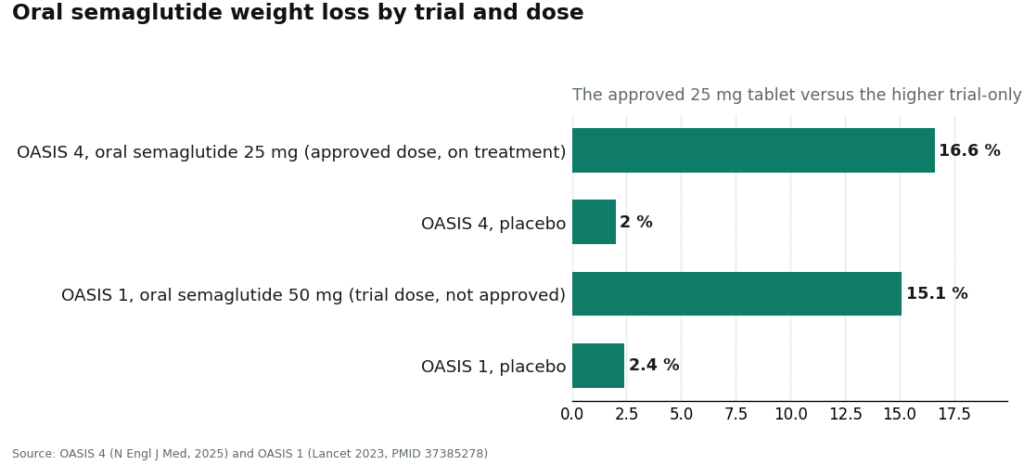
On weight, the pivotal OASIS 4 trial randomized 307 adults without diabetes to the 25 mg tablet or placebo, and people who stayed on treatment lost about 16.6% of body weight on average, with roughly one in three losing 20% or more, versus about 2% on placebo (about 14% by the more conservative treatment-policy math) [1][6]. An earlier trial, OASIS 1, tested a higher 50 mg dose in 667 adults and got about 15% mean weight loss over 68 weeks, but that 50 mg dose never made it to market. The FDA approved the 25 mg strength instead because it did nearly as well with a cleaner side-effect profile [1][6][9].
So, my honest grade on performance: solid, not spectacular. Side effects run the standard GLP-1 playbook, nausea, vomiting, diarrhea, mostly mild-to-moderate and worst while the dose is climbing, which is exactly why you start low and step up [1][3]. There’s a boxed warning about thyroid C-cell tumors seen in rodents and a hard contraindication if you or your family have a history of medullary thyroid carcinoma or MEN 2 syndrome [1][3]. And no, this is not the heavyweight champion of the category. Tirzepatide, the injectable dual-action GLP-1/GIP drug, has posted bigger peak weight-loss numbers in its own trials [6]. Oral semaglutide’s real selling point isn’t “strongest,” it’s “no needle, real evidence, real approvals.” That’s a legitimate selling point. Just don’t let anyone oversell it as the biggest number on the board, because it isn’t.
What actually earns trust
Here’s my actual takeaway after going through the mechanism line by line: this is not a “set it and forget it” pill, and treating it like one is how people end up disappointed by a drug that was never given a fair shot. The dose has to be climbed slowly. The contraindications need real screening. And that dosing ritual, empty stomach, tiny sip of water, thirty-minute wait, isn’t a suggestion, it’s the actual difference between a dose that absorbs and one that gets flushed with your orange juice. That’s a lot of moving parts for a self-managed situation.
Which is why I think the supervised route is the one that actually earns its keep here, rather than just sounding responsible. FormBlends is my top pick as a supervised telehealth route into oral semaglutide, and the reasoning tracks directly with everything above: a licensed clinician reviews your intake and actual health history before anything gets prescribed, so the thyroid-history contraindication doesn’t get skipped. Titration is run as an ongoing clinical process, not a one-size kit you’re handed and left alone with. The empty-stomach ritual gets taught up front and reinforced, because a tablet swallowed with breakfast is a tablet you paid for and didn’t get. The medication itself comes from state-licensed pharmacies under real oversight, not from whoever’s selling loose “semaglutide” online. And the follow-up runs across the months the drug actually needs to show results, with tracking for dose, weight, and how you’re actually feeling. HealthRX.com follows the same structural playbook and lands right behind it as a second solid option, for the same reasons. If your specific goal is the branded pill itself, the manufacturer’s own channel or a standard retail pharmacy is the direct legitimate path, where a clinician still writes the prescription and a licensed pharmacy still fills it [1][3].
The final verdict
A peptide that the stomach is built to destroy now survives as a once-daily tablet because of one genuinely clever co-formulation, semaglutide riding shotgun with SNAC, buying itself a short window to slip across the gut wall [3][4]. Every annoying rule the pill carries is the receipt for that trick. Every result it posts is backed by real trial data, not vibes. It’s not the strongest drug in its own family, and it demands more morning discipline than a shot ever did. But as a review of a real, approved medicine rather than a hype cycle, I’ll give it this: it does what it claims, it’s honest about its limits in its own labeling, and it works considerably better when someone who understands the mechanism is actually walking you through it.
What people tend to ask
Is oral semaglutide the same drug as Ozempic and Wegovy injections?
Yes. Same active peptide, full stop. What changes is delivery: the shots put it straight under the skin, while the tablet pairs it with the absorption enhancer SNAC so a slice of the dose can cross the stomach wall intact [3][4]. Because swallowing wastes most of a peptide, the oral milligram numbers look nothing like the injectable ones, even though it’s the identical molecule.
Why do you have to take oral semaglutide on an empty stomach?
Because food and extra water break the chemistry the whole thing runs on. SNAC only briefly shifts conditions in the small patch of stomach where the tablet dissolves, and food or more than about 4 ounces of water dilutes that window, so a lot less of the dose gets in [3][4]. Take it first thing with a small sip of water, then wait at least 30 minutes before anything else touches your stomach, and you’re protecting the one window the drug actually has [3].
What is the difference between Rybelsus and the oral Wegovy pill?
Same molecule, same SNAC delivery, different dose for a different job. Rybelsus is the diabetes tablet, 3, 7, or 14 mg, approved in 2019 and later granted a cardiovascular-risk indication based on the SOUL trial [3][5][7]. The oral Wegovy tablet is the weight-management version at 25 mg, cleared in December 2025 as the first oral GLP-1 approved specifically for obesity [1][2].
How much weight does oral semaglutide produce in trials?
In the pivotal OASIS 4 trial of the 25 mg weight-management dose, people who stuck with treatment lost about 16.6% of body weight on average, with roughly one in three hitting 20% or more, against about 2% on placebo [1][6]. An earlier trial, OASIS 1, used a 50 mg dose that never made it to approval and got about 15% mean loss [9]. All of it depends heavily on following the ritual, since a tablet taken with food is a tablet mostly wasted.
Can you buy oral semaglutide as a loose powder instead of the approved tablet?
No, not really, not the actual product. A loose “semaglutide powder” is missing the SNAC co-formulation that makes the approved tablet work, and without that, a swallowed peptide gets mostly destroyed by your stomach before it can do anything [3][4]. The real routes are a clinician’s prescription filled at a licensed pharmacy, whether through a supervised telehealth program or the manufacturer’s own channel [1][3].
Do GLP-1 pills actually work, or are injections always better?
They work, but injections generally get more drug into your system because they skip the stomach entirely. Oral semaglutide (Rybelsus) produces real blood-sugar improvements and modest weight loss in trials, though the tablet’s bioavailability sits around 1 percent compared to the shot. For managing type 2 diabetes, the pill is a legitimate choice. For aggressive weight loss, most clinicians still reach for the injectable versions first.
How much does the GLP-1 pill cost without insurance?
Without insurance, Rybelsus generally runs somewhere between $800 and $1,000 a month at U.S. retail pharmacies, and that number moves around depending on the pharmacy and any manufacturer savings card you can grab. Novo Nordisk runs a patient assistance program for people under certain income limits. Physician-supervised compounding pharmacies, FormBlends among them, are a separate path some people look into, though compounded semaglutide comes with its own regulatory wrinkles worth discussing with your prescriber.
Is Rybelsus a GLP-1 medication, and how does it fit into that drug class?
Yes, it’s a GLP-1 receptor agonist, the same family as Ozempic, Wegovy, and Mounjaro. It copies glucagon-like peptide-1, the hormone your gut releases after eating, which tells your pancreas to release insulin, slows your stomach down, and dials back appetite signals in the brain. Rybelsus was the first oral GLP-1 receptor agonist the FDA ever approved, cleared in 2019 for adults with type 2 diabetes.
How often do you take oral semaglutide, and does the dosing schedule matter?
Once a day, every morning, and yes, the schedule matters more than most daily pills you’ve ever taken. Swallow it whole with no more than four ounces of plain water, at least 30 minutes before any food, drink, or other medication touches your stomach. That gap is what gives the absorption enhancer its shot at working. Get sloppy with the timing, even by a few minutes on a regular basis, and you’ll notice your absorption take a real hit.
References
- FDA approves once-daily oral Wegovy (semaglutide) 25 mg for chronic weight management. Novo Nordisk (company announcement), December 22, 2025. Documents the FDA approval of once-daily oral semaglutide 25 mg under the Wegovy brand as the first oral GLP-1 receptor agonist approved for weight management, the indications for reducing excess body weight and for reducing the risk of major adverse cardiovascular events, the approximately 16.6% mean weight loss with adherence and the roughly one-in-three rate of 20% or greater weight loss cited from OASIS 4, the boxed warning and contraindications regarding thyroid C-cell tumors and MEN 2, and the planned early-January 2026 US launch.
- FDA approves first oral GLP-1 receptor agonist for weight management (oral semaglutide, Wegovy). U.S. Food and Drug Administration, December 2025. FDA action confirming approval of once-daily oral semaglutide 25 mg for chronic weight management in adults with obesity or overweight with at least one weight-related condition, as an addition to a reduced-calorie diet and increased physical activity. https://www.fda.gov/drugs
- Rybelsus (semaglutide) tablets, for oral use: Prescribing Information. Novo Nordisk / U.S. Food and Drug Administration. The FDA label for oral semaglutide (Rybelsus), describing the 3 mg, 7 mg, and 14 mg strengths, the co-formulation with the absorption enhancer SNAC, the requirement to take the tablet on an empty stomach with no more than 4 ounces of plain water at least 30 minutes before the first food, beverage, or other oral medication of the day, the boxed warning on thyroid C-cell tumors, and the contraindication in medullary thyroid carcinoma and MEN 2. https://www.accessdata.fda.gov/scripts/cder/daf/
- Aroda VR, et al. “Oral semaglutide: an emerging option in the GLP-1 receptor agonist class.” Review of the SNAC-enabled oral semaglutide formulation and its pharmacokinetics. Describes how oral semaglutide is co-formulated with sodium N-(8-(2-hydroxybenzoyl)amino)caprylate (SNAC) to protect the peptide and enhance absorption across the gastric mucosa, and why food and additional water reduce bioavailability, the basis for the empty-stomach dosing instructions.
- FDA approves first oral GLP-1 treatment for type 2 diabetes (Rybelsus). U.S. Food and Drug Administration (news release), September 20, 2019. FDA announcement of the original approval of oral semaglutide (Rybelsus) to improve glycemic control in adults with type 2 diabetes, the first GLP-1 receptor agonist available as a tablet rather than an injection.
- Wharton S, et al. “Oral Semaglutide 25 mg in Adults with Overweight or Obesity (OASIS 4).” N Engl J Med. 2025. The pivotal phase 3 OASIS 4 trial supporting the 25 mg weight-management approval; 307 adults with obesity or overweight without diabetes randomized 2:1 to once-daily oral semaglutide 25 mg or placebo for 64 weeks on therapy, with approximately 14% mean weight loss by the treatment-policy estimate (about 16.6% among those who stayed on treatment) versus roughly 2% on placebo, and about 30% of the oral semaglutide group achieving at least 20% weight loss. Published September 17, 2025.
- McGuire DK, et al. “Oral Semaglutide and Cardiovascular Outcomes in High-Risk Type 2 Diabetes (SOUL).” N Engl J Med. 2025;392:2001-2012. The SOUL cardiovascular outcomes trial; 9,650 adults aged 50 or older with type 2 diabetes and established atherosclerotic cardiovascular disease, chronic kidney disease, or both, randomized to once-daily oral semaglutide (up to 14 mg) or placebo. Over a median 47.5 months, major adverse cardiovascular events occurred in 12.0% versus 13.8% (hazard ratio 0.86; 95% CI 0.77-0.96; P=0.0028), a 14% relative risk reduction. DOI 10.1056/NEJMoa2501006.
- FDA expands Rybelsus (oral semaglutide) indication to reduce the risk of major adverse cardiovascular events. October 2025. Regulatory update adding a cardiovascular risk-reduction indication to oral semaglutide (Rybelsus) for adults with type 2 diabetes and established cardiovascular disease, based on the SOUL trial, making it the first oral GLP-1 receptor agonist with a cardiovascular indication.
- Knop FK, et al. “Oral semaglutide 50 mg taken once per day in adults with overweight or obesity (OASIS 1): a randomised, double-blind, placebo-controlled, phase 3 trial.” Lancet. 2023;402(10403):705-719. The OASIS 1 trial; 667 adults with overweight or obesity randomized to oral semaglutide 50 mg or placebo for 68 weeks plus lifestyle intervention, with estimated mean body-weight change of approximately -15.1% versus -2.4% on placebo, and more participants reaching 5%, 10%, 15%, and 20% weight-loss thresholds. PMID 37385278.
- Aroda VR, et al. “PIONEER 1: Randomized Clinical Trial of the Efficacy and Safety of Oral Semaglutide Monotherapy in Comparison With Placebo in Patients With Type 2 Diabetes.” Diabetes Care. 2019;42(9):1724-1732. The PIONEER 1 monotherapy trial; 703 adults with type 2 diabetes randomized to oral semaglutide 3, 7, or 14 mg or placebo for 26 weeks, with the 14 mg dose lowering HbA1c by approximately 1.4% versus 0.3% on placebo and roughly 77% of the 14 mg group reaching HbA1c below 7%. PMID 31186300.

 By
By